I have a bone to pick with the concept of the word natural, for several reasons actually. My gripe with the word natural initially came about from my mother nagging at me about using consuming “un-natural” products. For example, pharmaceutical medicine, foods that don’t have the organic label slapped on them, non-sugar sweeteners, and much much more. There’s a sort of perceived superiority for things that are quote-unquote natural.
And there’s certainly truth to the fact that processed foods and modern day preservatives aren’t good for you. There’s talk of how, often times, modern vegetables have decreased percentages of nutrients. There are all sorts of criticisms to human-engineered products and solutions that are at least subjectively, bad for you.
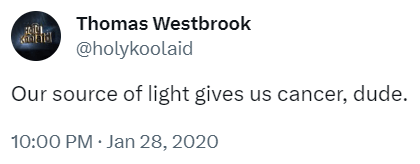
But this false pedestal that people often times have for “natural” things is just as ridiculous. Things are constantly in a state evolution, the current state of the world is not the definite final form. There’s no reason to believe that the natural state of things is by default the best option for us. As quoted by @holykoolaid on twitter,
It’s silly to suggest that just because something is natural, it is inherently better. As if the universe had specifically evolved in such a way to explicitly support our needs and interests. There are definitely cases where things in nature evolved to be mutually beneficial. Such as an apple evolving greater taste to attract animals into eating and distributing its seeds. But the apple has no will or intuition to make itself more healthy or nutritious. This happens through evolution, which is a completely happenstantial process. So you can’t apply that logic to every natural phenomenon. You have to be able to accept that man-made products are capable of surpassing nature. Since unlike nature, we are explicitly looking for ways to innovate and improve.
People far too often will use buzzwords like “chemicals” and “artificial” to label things in a negative light, as if the property of being man-made is inherently an inferior quality. Which once again, is quite silly. Everything in the universe (that’s physical) is a chemical! People look at the ingredient list for a vaccine shot and get terrified of all the long hard-to-pronounce names and don’t even register the fact that most of those chemicals appear naturally in many foods we consume. Then they have the audacity to advocate for pseudoscience cures that merely appear to be natural.
Much of Traditional Chinese Medicine is purely pseudoscience, but even if they did work, there’s nothing about them that makes them natural. How is skinning a donkey, melting its skin, cooking it with herbs, to create a gelatin-based blood tonic any more natural than just just creating some iron supplements in a lab? Does the cooking of donkey hide happen naturally in nature? Do you see donkeys spontaneously melt when you go on a small hike through the countryside? If you can replicate a medicine down to its exact chemical make up, what difference is there between if it was synthesized vs made from naturally occurring phenomenon? There is none.
Granted I will admit, nature is able to do certain achieve a lot of things we can’t. Vitamin supplements currently, while contain equal to or more of the nutrients we can get from a fruit, are harder for us to absorb into our bodies. But this isn’t necessarily surprising. Nature has had a couple billion years of head start. We have evolved in a way to fit the niche of being able to eat these naturally occurring things. But there’s no guarantee that’s the optimal way. I’m just saying there is no inherent goodness or badness to either nature or human created products. Using nature as a metric to define an object’s quality is not one that is all that useful.
 Binder Clip Scorpion
Leave a comment