
DISCLAIMER: this is an opinion piece but I will do my best to accurately portray the state of things as well as keep anecdotal evidence to a minimum. My goal is to present a nuanced take on the matter
It’s been a while since Nintendo announced that the Switch 2 will be taking advantage of a new method of game distribution: the Game-Key Card. I wanted to talk about it since there’s a lot of controversy around it and I think it’s worth exploring. It is a physical cartridge that acts as a download key for the game. The cartridge itself does not contain the game files, and an internet connection is still required to actually download the game. Once downloaded, the game files are stored locally on the console and the key-card simply acts as a license checker to enable access to the game.

There is some backlash to this. Many have likened this to a glorified download code-in-a-box with the added downside of contributing to more e-waste. Some claim this is strictly anti-consumer and is the worst of both worlds (both worlds meaning physical and digital). Others take a philosophical stance against this on the grounds of media preservation and right of ownership. But there’s also a lot of people defending this new system. Are they justified or are they just stubbornly defending a greedy multibillion dollar corporation?
I would like to explore these accusations and offer my perspective on the topic. Before we discuss what my thoughts on them are, or even the upsides and downsides of the Game-Key Card. Let’s talk about the why.
Physical media is expensive. Not that expensive, but still considerably more expensive than maintaining a server where people can just directly download their games from. I can’t find any legitimate sources on how much a cartridge costs Nintendo to produce. ROM storage is cheaper than flash storage but if we factor into proprietary hardware costs, we can assume Switch cartridges are somewhat comparable to a cheap SD card. So it’s not an insignificant amount of profit loss.
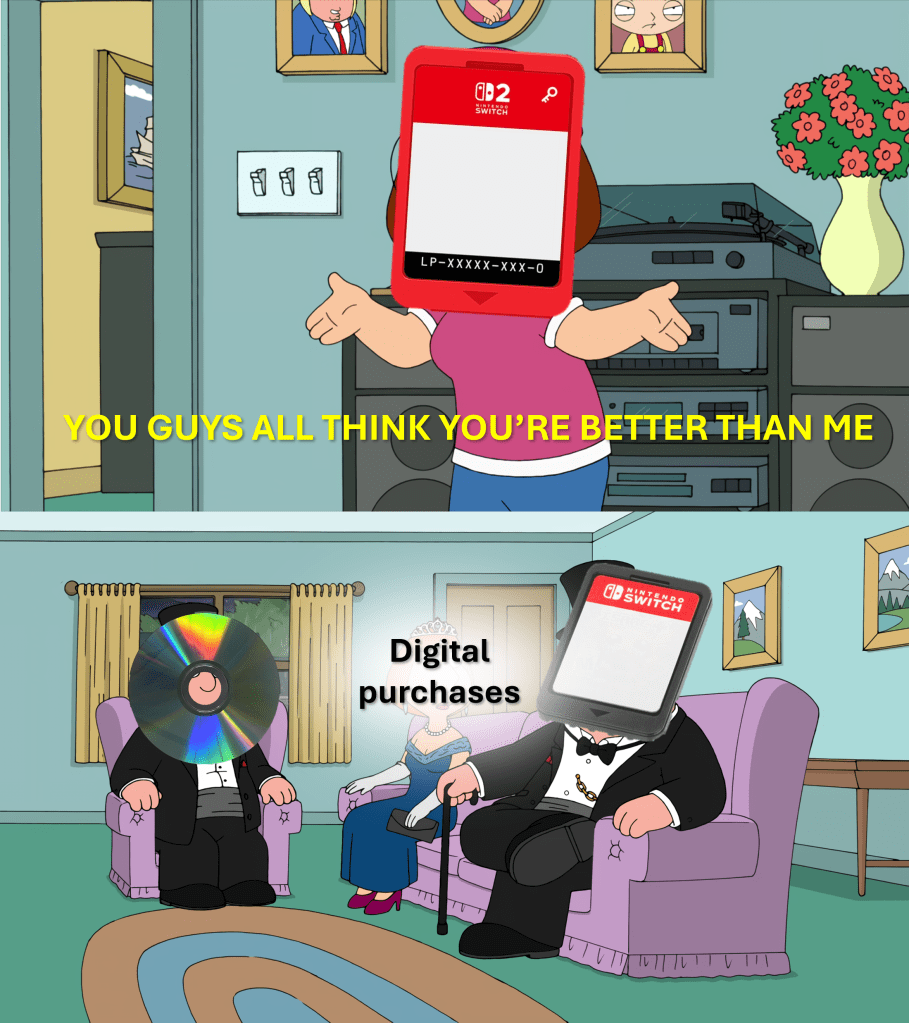
But people like physical. There are people out there who only buy physical. Sometimes for entirely superficial reasons; such as having a nice memento that can be displayed on a shelf, or a physical object that can be gifted (feels more personal than just giving someone a card with a download code). By not producing physical, you’re losing out on an entire potential group of customers.
Different companies have found ways to cut costs in different ways. Playstation and Xbox both use discs, which are waaaaay cheaper to produce than cartridges. But the downside is that discs are slower to read, so modern disc games are downloaded to the console itself and the game is being run from the internal memory. That’s why when you load a new game into your PS5 it has to download first before you can play it. The disc merely acts as a license checker so you still need to have the disc inserted to actually open the game (sound familiar yet?). Due to the portable nature of the Switch and Switch 2, discs aren’t a viable solution for obvious reasons. Cartridges offer the smaller form factor that makes them perfect for consoles like the Switch. But there is an additional benefit in the fact that cartridges have faster read times. So your switch doesn’t need to download anything, and can run the game directly off of the cartridge.
With this context out of the way, let’s talk pros and cons of the Game-Key Card.
Pro:
- It’s a physical item, and has potential superficial value to collectors and displayers
- It can be resold unlike regular digital purchases, since access to the game is still tied to the cartridge, in which you get unlimited downloads
- It saves developers money, which makes it more likely for games to be ported to the Switch 2 system
- Game is still stored on the eMMC, so load times are faster compared to reading off of cartridge
Con:
- Internet access is required to download the game and by extension you need to wait to download before you can play
- Game is stored on console and thus takes away storage space, which is devastating when considering large game sizes and the Switch 2’s tiny storage space
- It’s inconvenient to have to remove and insert cartridges or bring them along with you if you are traveling
- Losing or damaging the cartridge means you lose the game
Now I think is the part where we need to get into the nuanced discussion of right of ownership. Because I feel like this is one of the most misunderstood topics when talking about these kinds of things.
One of the most frequent pieces of criticism I hear when people talk about game key cards or digital games is that if the servers go down you lose your game forever and that means you don’t actually own the product you bought.
…
no?
Bought software is bought software. When you buy a digital game it gets downloaded to YOUR physical device that YOU own and it stays there until the rest of time. Whether the servers exist or not does not affect a game that is already downloaded onto your device. What is affected is your ability to redownload the game had you chosen to delete it. Which is a conscious decision you make. If you chose to remove a piece of software from your device without backing it up, that is your responsibility. Like you wouldn’t throw away your physical cartridge and then complain Nintendo won’t send you another one for free. And this is all ignoring the fact that “the servers will shut down” is a silly strawman scenario that’s not grounded in reality. To this day you can still redownload purchased games from the Nintendo DS era. Though the DSi shop has been closed for almost a decade now, you can still redownload games you’ve previously purchased. There’s no indication that Nintendo will change this short of the company getting wiped off the face of the Earth.

Circa 2079, colorized
Even in regions where you can no longer access the E-shops, Nintendo has made it clear that you can contact customer service to reinstate previously purchased content under the circumstances where you’ve deleted the game or never downloaded it in the first place.

Digital purchases are no less than physical purchases because the product IS digital. It’s just a difference of where the product is stored. Whether on an external disc/cart or within your device. In that sense, Game Key Cards are not an attack on your “right of ownership”. I think people will hear words like “purchase” and “ownership” and set wrong expectations. Like if I purchase a movie ticket I wouldn’t then assert I have ownership of the movie and should get a copy of it. I’m understanding that I’m paying for the experience of watching it in a theatre environment. Just like how when I buy a game for a console I understand that I am buying the ability to use the software on the device that I own. (*edit as of 11/24/2025, I added some additional context at the bottom)
But what about media preservation? How do you square that?
So I think it is important to keep in mind the purpose of preservation. The point is accessibility. It’s not preservation for an unopened mint condition copy of Pokémon Red to sit in the collection of some rich private collector or some random museum behind locked glass. Preservation is about these pieces of media still be accessible to regular folks so that they can enjoy and experience them without unreasonable difficulty. Hardware degrades, discs get scratched and broken, cartridge internal batteries die and corrode. The true way to archive and preserve video games as a medium is emulation. I’m of the opinion that studios should release the decompiled code once the game is in the public domain. Studios will hate this but I do genuinely believe this should be done. Maybe that won’t happen, but ports and virtual console are steps in the right direction. People worrying about Game Key Cards being anti-preservation are missing the point. Console video games are already anti-preservation. They are forever locked away on the device they were designed for. Playable only under the conditions allowed by the hardware and OS. That’s why for every generation of consoles that release, there’s a dedicated team working furiously to crack and jailbreak said console. Or a team dedicated to creating an emulator. These are the things that are actually important to preservation: crime. Crime is good.
“Wow Alex, you’re glazing Game Key Cards so much you must really love them”
NO
I HATE THEM. But I actually have a good reason, unlike any of the dumb silly ridiculous foolish reasons mentioned previously. Which is the fact that Nintendo has now gotten into the business of offloading storage responsibilities onto the user.
Nintendo is the last console that uses cartridge technology. And in the era of games that have like +100GB file sizes, storage space has become a valuable resources. Cartridges with the full game files are strictly pro-consumer and just genuinely a good thing for players everywhere. The introduction of Game Key Cards would not nearly been as bad if it was offered as a third option alongside digital and physical. But it is fully replacing physical releases for many games, even titles that are directly published by Nintendo like Pokopia.
The part that sucks is part of this is Nintendo’s fault, for not offering more cartridge file sizes. It used to be the case that third party developers can choose between a selection of cartridge sizes that best fit their games. For the Switch 2, the only two sizes are now Game Key Card and 64 GB. The 64 GB option would be overkill and too expensive for a small game so everyone is incentivized to just choose the Game Key Card option.
This is also bad because it means devs aren’t optimizing their games properly. Game optimization used to be an art. Limitations bred creativity. Now you got games like Final Fantasy VII Remake being 90+ GB because fuck it, storage isn’t their problem anymore. It’s yours.
11/24/2025 Edit:
Upon further reflection, I think there is a little bit more nuance worth discussing when it comes to digital ownership. Technically with the way the Switch works, digital purchases must be made through a Nintendo account. The software is technically tied to the account, not the console. So if you were to delete your account, the games would be gone. This is a worrisome concept since Nintendo reserves the right to terminate your account per their EULA.

To be clear this is not unique to Nintendo and this sort of clause exists across all major game platforms including even Steam. As all digital storefronts operate using an account system. The worrying aspect is that if they terminate your account you do in fact lose all of your purchased software. For the Nintendo Switch, physical games are playable without the need for an account nor any online connectivity.
But to be clear, there is no precedent of Nintendo permanently deleting someone’s account, thus removing their purchased software. I did some searching and have found many instances of users being banned from accessing the e-shop or participating in online multiplayer. But even users who have been caught pirating games have not had their consoles straight up “bricked” by Nintendo. The EULA dictating that Nintendo may terminate an account is not even necessarily enforceable given that if you keep your console off the web, it cannot be affected by any third party in any shape or form.

Technically the EULA even states that breaking the agreement means you can’t use their console period. Obviously this isn’t realistically enforceable, and there’s no precedent that Nintendo will personally send you a firmware update to brick your console (despite what many clickbait headlines will lead you to believe). But I do understand the frustration of there being another layer between true ownership of a software and what we experience when we buy digital games.
This does surprisingly mean the Game Key Card has another benefit over a digital purchase since the Game Key Card downloads are not tied to an account and can be reused an infinte amount of times. So even in the worst case scenario of your acount being deleted, you can still redownload a game using the Game Key Card.
 Binder Clip Scorpion
Leave a comment