
The other day I was thinking about how 0.99999 repeating is equivalent to the number 1. Which suddenly got me wondering, how can this actually be true? 0.999… is only a representation of the closest we can get to the integer one using the symbols available to us in base ten (decimal counting system). Because 9 is the closest symbol we have before the next place value. But hypothetically, if we were to have a symbol that’s even closer to the next place value, then wouldn’t that be closer to one?
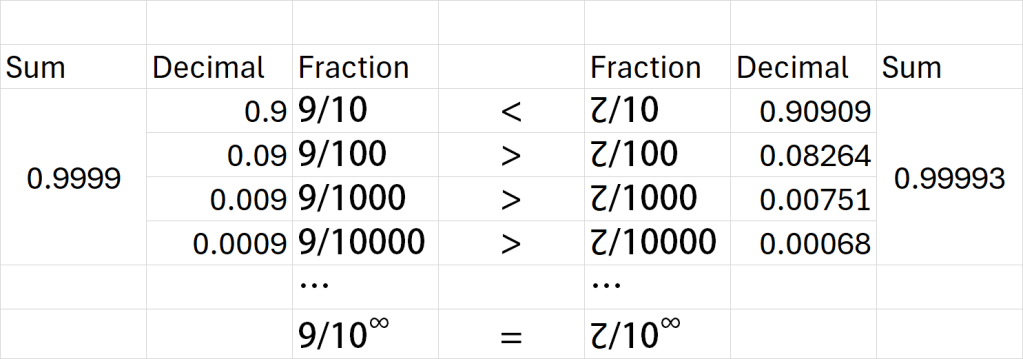
For example consider a base eleven (undecimal) counting system where between 9 and 10, we had a new number called ↊. So in this scenario, ↊/10 in undecimal is greater than 9/10 in decimal. So wouldn’t 0.↊↊↊… in undecimal presumably would be a closer approximation to 1 than 0.9999… is in decimal? How can both equal to one?
I then started thinking about it in the opposite direction. For example in base 3 (trinary), the closest possible way to represent 0.999… would be 0.222…
At first glance it seems absurd that 0.999… in decimal is equivalent to 0.222… in trinary. But if you begin to break it down into fractions, you’ll notice something cool. In decimal, 0.999… can be written as 9/10 + 9/100 +9/1000… And in trinary it would thus be written as 2/10 + 2/100 + 2/1000… But if you translate the trinary fractions into decimal, it would be written as 2/3 + 2/9 + 2/27… or in other words,
It’s an interesting quirk of how infinite sums work. It doesn’t matter that two numerical system will have a different value for each n, when you increase n to infinity, it still ends up being the same.
It also gives us an interesting way to write the number one
Where k is any positive constant (including non-whole numbers… which I guess makes sense because technically you can have numerical systems with a base that is a non integer).
 Binder Clip Scorpion
Leave a comment