
A while back I saw this post by Reddit user xiadmabsax create this terrible phone number input UI. It’s part of an intentionally bad UI design challenge.
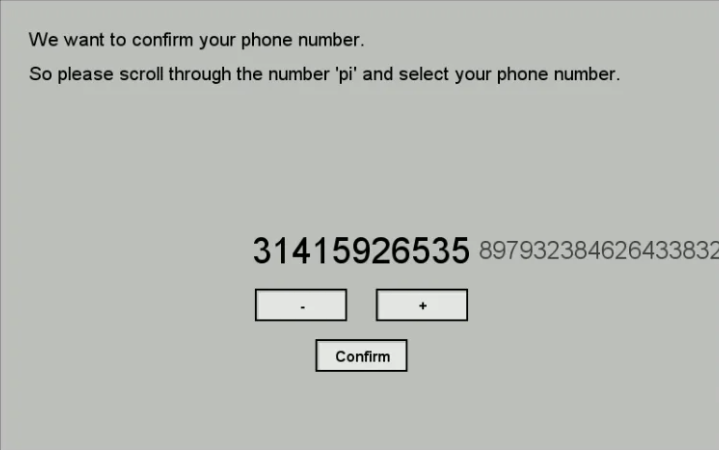
It’s a funny concept, but it got me thinking about if it was even possible for pi to contain every combination of phone numbers. At first glance it sounds like it checks out. Pi is infinite and seemingly random. Surely at some point down the line you’ll find your phone number and every other phone number out there. But can you mathematically prove it?
So the proven properties of pi are that it is infinite and non repeating. These are established properties that it has on behalf of the fact that it’s an irrational number. But infinite + non repeating does not necessarily guarantee it contains every sequence. For example, 0.101001000100001… is also an infinite non repeating number. And yet it’s pretty obvious it will never contain all phone numbers. Or what about a number that is the exact same as pi except every instance of the digit 8 is removed? Or a number that’s like pi except you insert a 5 in between each digit?
What we’re actually looking for is what’s called a normal number. A normal number is an irrational number that has its digits occurring at an uniform rate. This comes with the property of containing all finite sequences. Currently from what I’ve read online, there is no proof that pi is a normal number. Meaning there is no guarantee that your phone number can be found within pi.
I wonder if it is impossible to prove that pi is a normal number. I’m not talking about proof of impossibility, I’m talking about the proof of impossibility for the impossibility to prove pi is a normal number. Some problems have solutions that can be proven. And other problems have no solutions, which can also be proven. Like you prove that 1+1 = 2 or prove that 0 = 1/x has no solutions. But sometimes there are situations where there is a solution, but it is impossible to prove. This is laid out by Gödel’s incompleteness theorems. Like the question of “is pi a normal number?” The solution is either yes or no. But perhaps there exists no proof of it. But is there a proof that there is no proof? How do we know that we just haven’t found a solution yet? It’s a little bit more easy to visualize with a defined logic problem. For example, can we prove that an omnipotent being, who does not want to be discovered, exists? By definition, the being has the ability to prevent us from proving he exists. Meaning there is a definitive “yes” or “no” to the question. But we literally cannot prove it.
So maybe we can’t prove if pi is a normal number or not. But phone numbers are finite. Taking into account of how many area codes there are in the US and restrictions on certain digits, there are around 3 billion possible phone numbers for consumer use. Meaning we need only focus on finding 3 billion unique 10 digit sequences within pi. An algorithm can be created to check every digit and it’s next 10 digits and log every sequence until we theoretically exhaust all the phone number combinations. Perhaps we’ll get lucky and actually be able to complete the task even if pi isn’t a normal number. Otherwise, poor xiadmabsax might have to act as customer support and deal with angry users complaining about not being able to find their phone numbers in pi.


 Binder Clip Scorpion
Leave a comment